About the Project
The overall goal of SOMA is a Socio-cultural study of Human Remains and Objects from Mortuary Assemblages in Athens to reach a new level of understanding of the (trans)formations and structures of societies living in the area of the City of Athens during the 2nd and 1st mill. BC, i.e. from the Bronze Age to the end of the Hellenistic Period.
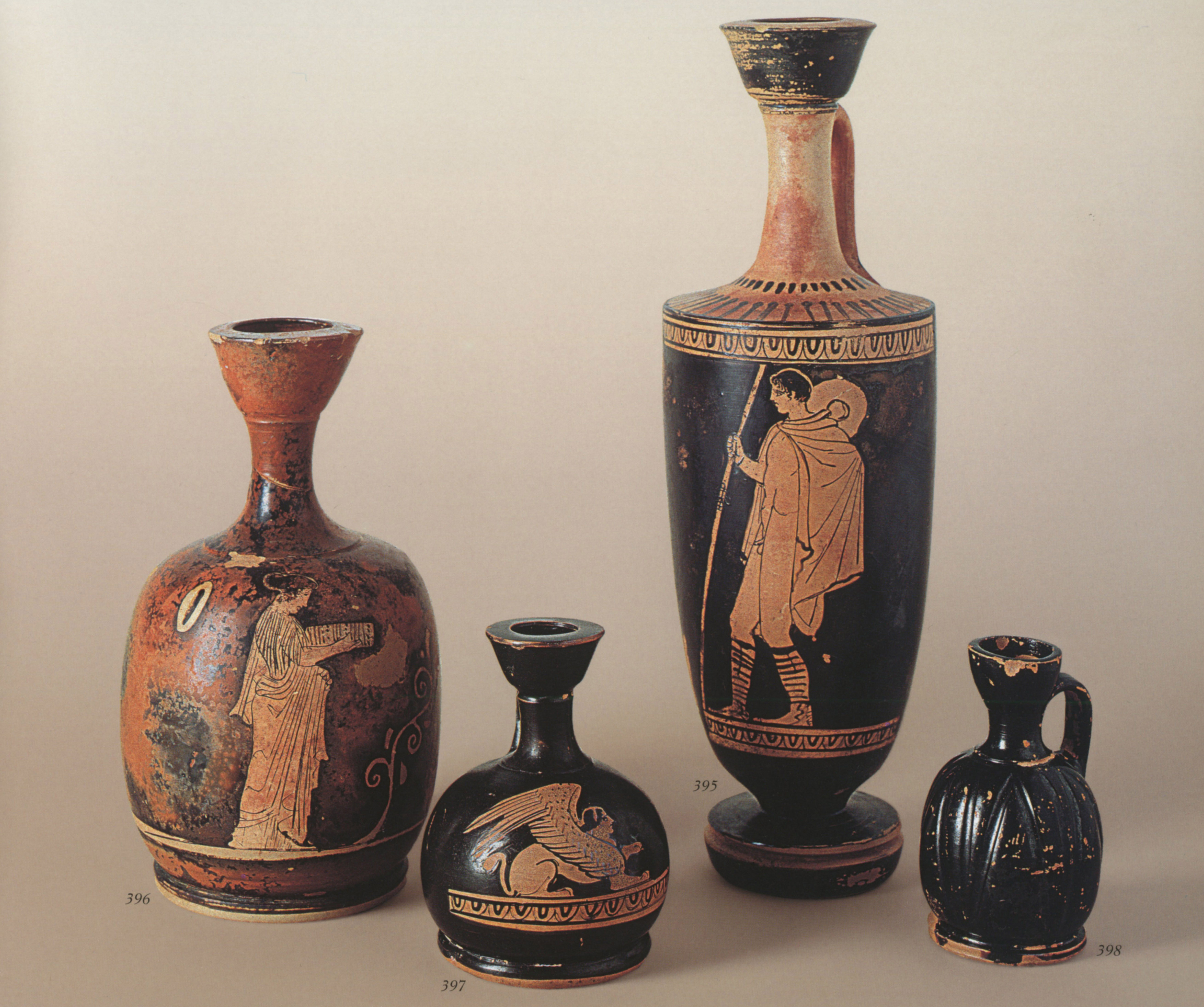
Studying these societies, their practices of belonging, diversity and the role of migration is crucial, as it helps us to understand - among others - the roots of democracy. We will study how societies in this area used burial practices and material culture to express status, cultural identities, concepts of the world, and aesthetic preferences. We will create and publish a corpus of ca 5.000 graves from that periods excavated by the Greek Antiquities Authorities (“Ephorate”) of the City of Athens, thereby integrating archaeological and scientific data (ancient DNA, isotopes) about relatedness, mobility, health and nutrition. Our corpus will comprise all contextual information of ca 20.000 objects (pottery, body adornments, grave stelae, inscriptions etc.) and the anthropological and scientific data. As published contextual and anthropological information for 2nd and 1st mill. BC graves from Athens are very limited at the moment, we will contribute significantly to Greek Archaeology and Ancient History. We will make this material accessible to the scientific and wider audience and provide answers to long-existing but so-far unanswerable questions regarding e.g. the (trans)formation of kinship and related practices over time and the scale, impact and role of migrant groups. We will study the interplay of biological and social factors with regard to belonging, age/stages of life, sex/gender, diet and health and the correlation of these aspects with burial goods and grave architecture. We will compare population genomic and cultural transformations over time, infectious diseases, specific marital practices like cousin-cousin-unions and the role of material culture and images in this dynamic interplay of genes and practices.
SOMA's potential is based on the unique collaboration with the Ephorate and the Greek Ministry of Culture, which invited us to study this so far inaccessible corpus and evaluate the material in close collaboration. In an unprecedented manner, the Greek Ministry of Culture and the Central Archaeological Council of Greece decided that the Ephorate and SOMA can sign a legal agreement guaranteeing a sustainable, 25-year-long close collaboration. With its multimodal approach (archaeological, textual, physical anthropological, archaeogenetic, isotopic data), SOMA sets new standards concerning the integration of Humanities and the Sciences in the framework of an Academy project. SOMA undertakes the basic evaluation and publication of the 2nd-1st mill. BC graves, combining the physical anthropological evaluation of the skeletal material regarding age, sex, injuries etc. (Research Approach “Bioarchaeology”) and the the study of grave contexts (spatial setting, grave types/markers etc.) and grave goods (e.g. pottery, bronzes, jewellery) (Research Approach “Socio-Cultural Studies”).
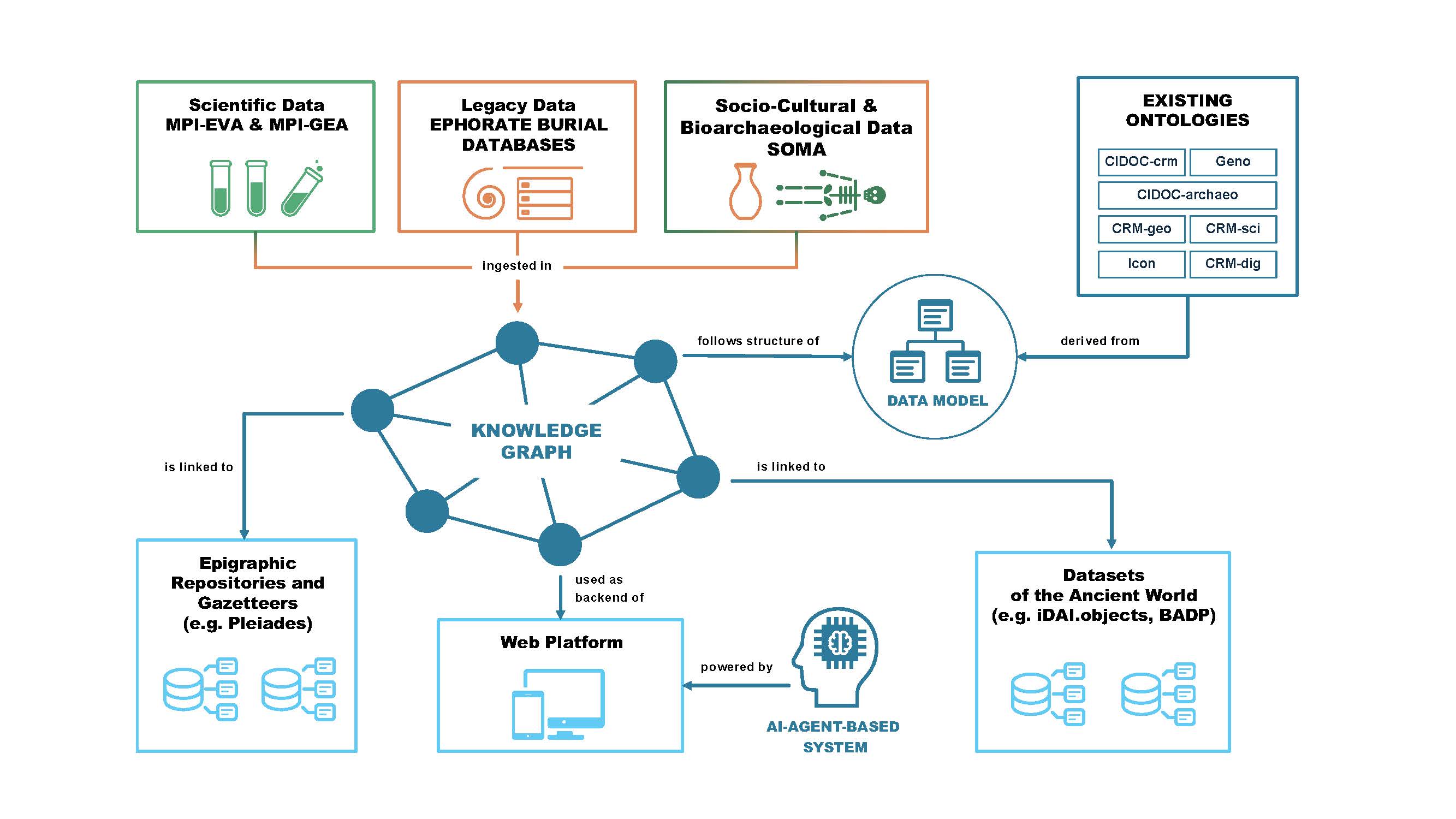
The Max Planck Institute (MPI) for Evolutionary Anthropology will take over and fund the scientific (ancient DNA, isotopes) and bioinformatic analyses. The evaluation is divided into 5 phases à 5 years following the chronological sequence of the graves, with ca 1.000 graves being evaluated within each phase. All data will be united within Research Approach “Digital Humanities” (DH). DH will create a state-of-the-art web platform integrating a semantic database with geospatial capabilities, Large Language Models (LLMs) and Artificial Intelligence (AI)-powered tools for query, visualisation and data processing to be used by the scientific and general audience. Moreover, we will advance DH approaches to archaeology by developing novel AI-based tools for knowledge discovery and image production. The semantic character of the database will enable the integration of existing databases from the Ephorate. Our database will be interlinked with further repositories and databases, e.g. with epigraphic, historical or bioarchaeological information. The corpus will be published based on an interactive web platform, featuring GIS-based and semantic web capabilities combined with AI-based tools.